PRESIDENT’S REPORT: 43RD ANNUAL SYMPOSIUM ON SEA TURTLE BIOLOGY AND CONSERVATION, 22-27 MARCH 2025, ACCRA, GHANA
ANDREWS AGYEKUMHENE
President, International Sea Turtle Society (ISTS Symposium 43)
Department of Marine and Fisheries Sciences, University of Ghana, Accra, Ghana
aagyekumhene@gmail.com; aagyekumhene@ug.edu.gh
Download article as PDF
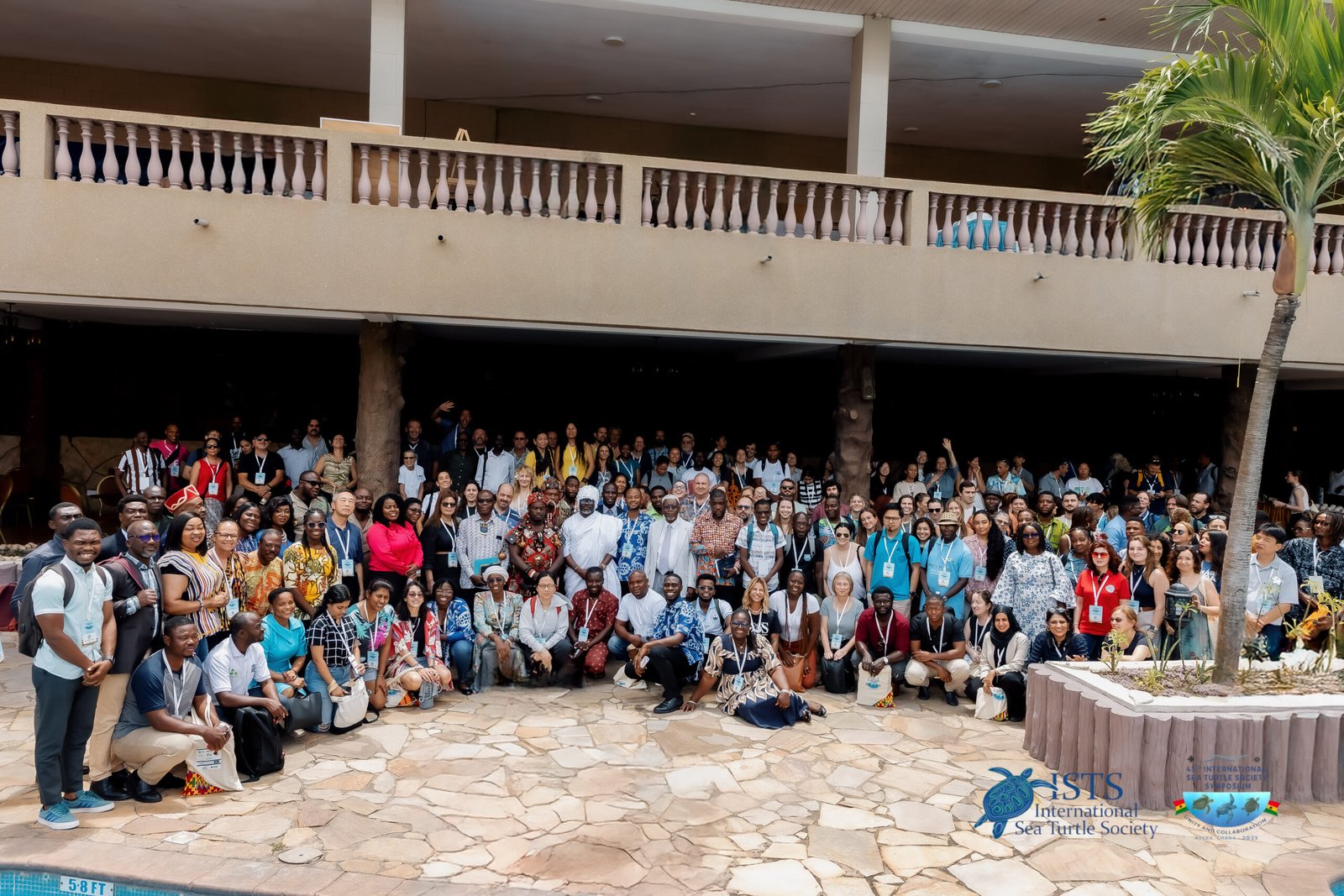
The 43rd International Sea Turtle Symposium marked a historic milestone as the first ISTS Symposium ever hosted in Africa. Held in Accra, Ghana from 22nd to 27th March 2025, this groundbreaking event brought together over 350 registered participants from 65 countries, including experts, conservationists, students, government officials, and grassroots practitioners. The central theme, “Unity and Collaboration,” underscored the power of cross-sector partnerships, regional cooperation, and inclusive scientific exchange to address the pressing challenges in sea turtle conservation.
The event featured an impressive suite of activities, including seven capacity-building workshops, four regional meetings, 138 oral presentations and 112 posters in key thematic areas such as innovations in nesting biology, in-water monitoring, fisheries interaction, and socio-economic engagement. Students played a prominent role, benefiting from a “Speed Chatting” session, networking opportunities, and mentoring.
In addition to its rich scientific content, the symposium embraced Ghanaian cultural expressions and traditions, fostering a unique atmosphere of warmth and connection. Social events, a vibrant exhibition space, and a dynamic awards ceremony further contributed to the symposium’s success. The 43rd ISTS Symposium not only marked a milestone for the International Sea Turtle Society but also deepened its commitment to inclusion, regional equity, and forward- thinking conservation action. The event concluded with a heartfelt celebration at the Farewell Banquet, where awards were presented and the ceremonial trowel and jacket were passed to the incoming President for 44th ISTS Symposium.
Logo
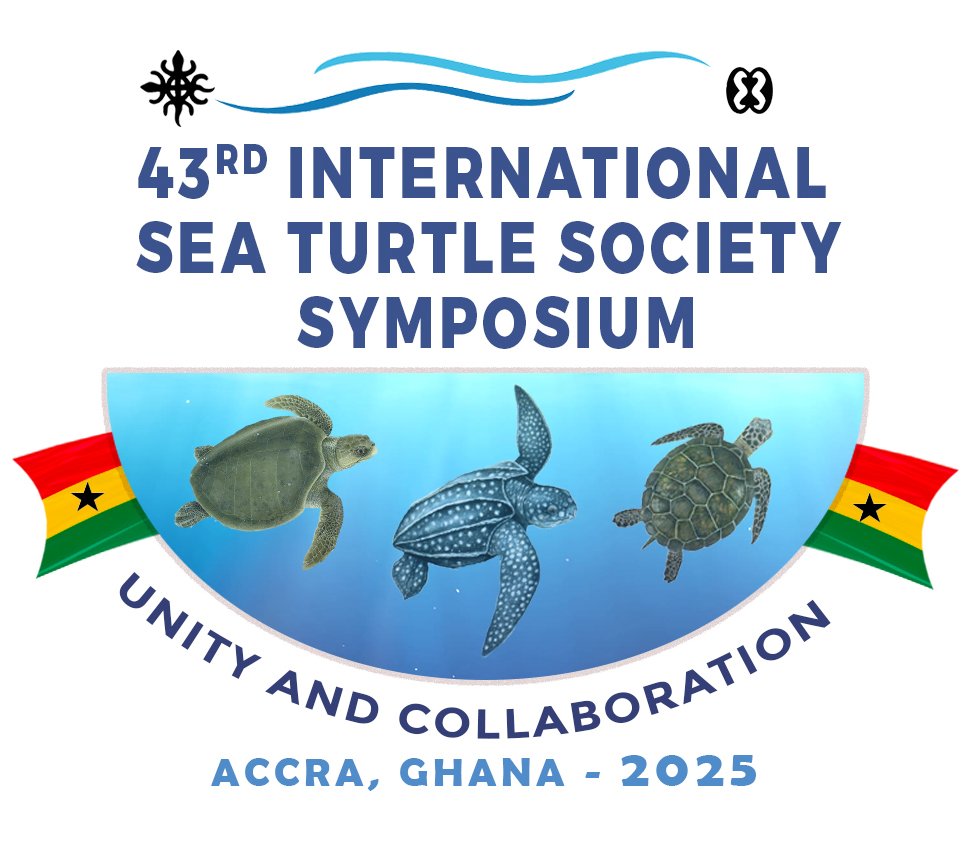
The symposium logo was designed by Fiifi Simons. The logo shows the Ghanaian flag on both sides of the ocean (blue semicircle) indicating the host country for the symposium and also serving as a reminder of the hospitality and cultural diversity of Ghanaians. Swimming in the ocean are the three species of sea turtles (olive ridley, leatherback, and green) which are commonly found in Ghanaian waters and nest on the country’s beaches in considerable numbers. These species are also common in most African countries. Above the symposium name are two Ghanaian symbols that signify Unity. On the left is the “Funtumfunefu Denkyemfunefu” or “Siamese crocodiles” which feature two conjoined crocodiles symbolizing unity in diversity and the importance of working together for a common purpose even in the face of conflict or competition. On the right is the “Nkonsonkonson” which means “chain link”, a symbol of unity and community (human relations). The combined elements of the logo convey the message that in unity lies strength, echoing this symposium’s theme of Unity and Collaboration, as captured in the logo under the ocean.
Reducing Our Plastic Footprint
Every effort was made to make the symposium more environmentally friendly. No plastic was used during coffee breaks or other events. All registrants received a souvenir coffee mug emblazoned with the symposium logo to use during breaks. Bottled water was not served during breaks; water dispensers were provided instead. Additionally, paper cups were provided during coffee breaks and alongside the water dispensers for participants who did not carry their mugs with them. All name tags were made of hard cardboard instead of plastic. Instead of printed mailings, announcements were distributed through email lists, the ISTS website and various social networks.
Sea Turtle Necropsy Session
A sea turtle necropsy session was held on 21st March 2025, before the start of the symposium. This session was specially dedicated to African students who were interested in the topic but opened to all participants. The session included lectures on sea turtle anatomy and physiology, threats (diseases and injuries that affect sea turtles), and basic techniques for addressing bycatch issues such as removing hooks. The lectures also touched on the conservation significance of necropsy. The laboratory session involved performing necropsy on an olive ridley turtle as well as handling and safety procedures for working with deceased sea turtles. The necropsy session lasted for six hours and was instructed by Daniela Freggi (team lead), Mariluz Parga, and José Luis Crespo.
Workshops and Regional Meetings
Workshops and regional meetings were scheduled for the two days prior to the main four-day Symposium. These early events provided participants with opportunities to share research techniques and exchange information on environmental and sea turtle conservation issues. Six workshops were held on 22nd March 2025, offering capacity building and promoting peer-to-peer learning. The workshop were: (1) Harnessing the Power of Social Media for Non-Profits & Individual Researchers; (2) Sea Turtle Rehabilitation, Care and Medicine; (3) Creating Behavior Change Campaigns for Sea Turtle Conservation; (4) Toward Holistic Strategies for Fisheries Sustainability and Bycatch Reduction; (5) 5th Environmental Education Workshop: Interdisciplinary and Collaborative Environmental Education Projects; (6) Male Sea Turtles: Global Research Update and Methodology Development for Guiding Conservation Efforts. An additional workshop was scheduled on 23rd March 2025, as part of the Student Committee activities: Career Paths and Techniques in Sea Turtle Conservation.
Four regional meetings on 23rd March 2025 brought together stakeholders from Africa, the Mediterranean, Indian Ocean & Southeast Asia, and Latin America (RETOMALA). These meetings allowed regions to reflect on their specific challenges and strengthen collaborations across borders. The African Regional meeting was held all day to allow updates from projects from across Africa since it was the first opportunity for many of such projects to share their work at an ISTS Symposium. The meeting emphasized the need for projects across the continent to work together under the Symposium’s theme: “Unity and Collaboration.” A total of 93 participants from 24 countries attended the meeting representing the largest participation of African projects ever recorded at this type of meeting.
Main Symposium Program
The main Symposium began with prayers, and to make it even more unique, a traditional Ghanaian prayer was offered by pouring of libation to the gods by Nuumo Akwaa Mensah III (Nai Wulomo), as the tradition of the land demands. The Dean of the School of Biological Sciences at the University of Ghana, Professor Langbong Bimi (with the address delivered on his behalf by Dr. Francis Gbogbo), officially welcomed participants to the 43rd International Sea Turtle Society Symposium, highlighting the significance of hosting the event in Africa for the first time. He emphasised the University’s ongoing commitment to marine conservation and called for unity and collaboration to address the global challenges facing sea turtles. His speech was followed by opening remarks from Dr. Benjamin Botwe, Head of the Department of Marine and Fisheries Sciences at the University of Ghana. This was followed by a poetry performance by Mr. Osei Kwame Korankye of the University of Ghana’s School of Performing Arts. His performance, titled “Message from the Unsung Hero,” set the stage for the President’s address.
Dr. Andrews Agyekumhene, President of the International Sea Turtle Society, welcomed participants to the 43rd International Sea Turtle Society Symposium in Accra, Ghana, marking the first time the event has been held on the African continent. His speech emphasized the theme of “Unity and Collaboration,” urging attendees to work together, overcoming differences, to protect sea turtles. He highlighted the major threats facing sea turtles and called for inclusive, community-driven, and decolonised approaches to conservation, emphasizing that meaningful impact is only possible through collective action. The President’s speech was followed by three keynote speakers.
Mr. Ayaa Kojo Armah delivered the first keynote address on the topic, “Consolidating Sea Turtle Conservation in Ghana and Developing Countries.” Mr. Armah, a former Head of the Department of Marine and Fisheries Sciences at the University of Ghana and current CEO of ESL Consulting Limited, reflected on Ghana’s history of sea turtle research and highlighted the role of international support in initiating early studies and conservation efforts. He emphasised the need to strengthen local initiatives in the face of declining external funding and advocated for practical national strategies and stronger regional collaboration through platforms like the UNEP Regional Seas Programme.
Dr. Noble Asare delivered a keynote address on behalf of Prof. Denis W. Aheto, Vice Chancellor of the University of Cape Coast and Director of the Africa Centre of Excellence in Coastal Resilience (ACECoR). He addressed attendees on the theme of “Unity and Collaboration” in sea turtle conservation. His speech highlighted the urgent need for global collective action to tackle threats such as climate change, habitat loss, pollution, and bycatch. He emphasised that conservation success is possible through community-based efforts, scientific innovation, and strong partnerships, urging participants to conclude the symposium inspired and committed to united and tangible action.
Conservation partners, such as the Forestry Commission’s Wildlife Division and A Rocha Ghana, also delivered solidarity messages. Both outlined the current threats to sea turtle in Ghana and their ongoing efforts and commitments to support the fight against these threats. The Wildlife Division pledged to intensify its efforts to enforce laws that comprehensively protect sea turtles in the country, while A Rocha Ghana pledged its unwavering support for raising awareness about the species. Both partners called for a more united front among stakeholders to advance sea turtle conservation efforts nationwide.
Special Session: Decolonising Conservation
The main symposium program then started with this session, which examined how colonial legacies shaped conservation by displacing Indigenous communities and marginalising traditional local knowledge. The session called for community-centred sea turtle conservation, reconciliation ecology, and co-production of knowledge between science and traditional beliefs. It also highlighted how the International Sea Turtle Society has promoted equity by expanding symposia in the Global South over the years, funding grassroots and student grants, and diversifying leadership. Recommended future actions include remote participation, multilingual inclusion, and increased representation to ensure equitable and sustainable conservation.
Oral and Poster Presentations
Immediately following the special session, oral and poster presentations took place from 24th March through 27th March. Program Chairs Phil Allman, Kate Levasseur, Katrina Phillips, and Liliana Colman, along with Poster Chairs Phil Allman, Gustavo Stahelin, and Kelly Sloan and 41 Session Chairs, developed the symposium program consisting of 138 oral and 112 posters presentations within nine session categories: (1) Anatomy and Physiology; (2) Conservation, Management and Policy; (3) Education, Outreach and Advocacy; (4) Fisheries and Threats; (5) In-Water Biology; (6) Nesting Biology; (7) Population Biology; and (8) Rehabilitation and Health. In addition to the traditional regular sessions, two side meetings were also held: “Marine Turtle Specialist Group (MTSG) Meeting”, and “Lunch and Learn: Freshwater TSA”.
Video Night
Patrick Abbeyquaye, John Selasi Yao Agudogo, Sampson Kofi Mawuko Kudior gathered 26 short films from 21 countries across Africa, the Pacific, the Americas, Europe, and the Middle East. The stories came from Ghana, Cabo Verde, Mauritania, Guinea-Bissau, São Tomé and Príncipe, Egypt, Jordan, Tunisia, Madagascar, South Africa, the Seychelles, Fiji, Panama, Grenada, Brazil, Mexico, USA, France (French Guiana, French Polynesia, and Reunion Island), Spain, and Maldives. These striking visual stories highlighted the diverse ways communities, researchers, and organizations are working to protect sea turtles and their habitats. The videos were publicly screened on the evening of 24th March. The Video Night was attended by just over 100 people and featured free popcorn for the audience.
Origin Stories
This year, we used a blended approach allowing participants to share indigenous stories and experiences working with sea turtles in the field. A total of 52 participants participated in the event and shared 20 stories and experiences. The event was led by Patrick Abbeyquaye and John Selasi Yao Agudogo.
Student Committee Activities
The Student Committee, chaired by Janie Reavis with support from Chandana Pusapati, Abhishek Thawait, Aiyana Reissman, Mildred Alpizar, Sarahi Ramos, Emily Turla, Lucas Capitão, Fitra Nugraha, Heather Seaman, Rachel Southards, Lindsay Curl, and Derek Aoki, coordinated activities designed to welcome and assist student attendees. Three activities were held:
The Student Workshop “Career Paths & Techniques in Sea Turtle Conservation” was held on 23rd March. Twenty- three students participated. This workshop offered valuable insights into diverse career paths in sea turtle conservation, including consulting, academia, government, and nonprofit sectors. Presenters Hamed Mallat, Ana Rita Patricio, Christine Figgener, Rowan Calder, and Kevin Lay shared professional experiences and practical advice. The session also included live demonstrations of key field techniques, such as PIT tagging, flipper tagging, and satellite tagging, providing hands-on learning opportunities for future conservationists.
Student Social Mixer This aimed to promote networking and communication among students, took place on the same day, 23rd March, just prior to the Welcome Social. The gathering offered a relaxed and exclusive space for the 23 participating students to connect and interact. For an hour, students engaged in informal introductions and conversations, which helped to break the ice and create a sense of community. This session was designed to foster early connections between participants at similar stages of their academic and professional journeys, setting the tone for a collaborative and welcoming symposium experience.
Speed Chatting with the Experts The event took place on Monday 24th March, and offered a dynamic and informal setting for 30 participating students to interact directly with leading experts in sea turtle research and conservation. Inspired by the concept of “speed dating,” this session allowed participants to chat one-on- one for 10 minutes with each expert, asking questions about their research, career paths, or even their own projects. It served as an accessible platform for dialogue, mentorship, and networking, especially for students eager to connect with professionals whose work they have studied or admired. For most of the students, this was a unique opportunity to meet in person with authors whose work they have used and cited in their research or whose work they have heard about. Eight distinguished experts generously volunteered their time and expertise: Matt Ware, Manjula Tiwari, Hiltrud Cordes, Brad Nahill, George Shillinger, Tony Nalovic, Kate Mansfield, and Kartik Shanker.
Sea Turtle Trading Post
As some groups working in sea turtle biology and conservation have surplus equipment and supplies that are rarely used or no longer needed, this event was introduced to find another purpose and use for such equipment. The sea turtle community is invited to donate new or gently used field and lab equipment, and those interested in acquiring each item of equipment could enter their names into a drawing. A total of 111 participants from 36 countries (predominantly Africa) signed up for the turtle trading post. Thirty-eight items were donated to the post for an approximate value of $5,500. The donated items included a drone, GPS units, backpacks, two-way radios, inflatable solar lanterns, PIT tag readers, PIT tags, biopsy punches, field lamps, and measuring tapes. The beneficiaries were primarily students, as well as projects from low-income countries. The turtle trading post was chaired by Kate Mansfield, assisted by Abigail Baidoo and Ryan Welsh.
Silent and Live Auctions
The silent auction was organized by Marina Zucchini, while the live auction was hosted by Rod Mast, assisted by Marina Zucchini. Nearly 300 items were donated to both live and silent auctions, of which 216 were sold in the silent auction and the rest in the live auction. A total of US$13,578 was raised across both auctions, of which $3,668 was raised in the silent auction. We thank everyone who donated items, bid, and fought for their favourite items. All proceeds will fund travel grants for next year’s symposium.
Social Events
The social component of the symposium included the Welcome Social, Student Committee activities, the Awards Ceremony, and the Farewell Banquet. The Welcome Social and Cultural Night was held at the Mensvic Grande Hotel Poolside on 24th March. Participants danced to authentic Ghanaian music while enjoying networking and having fun conversations.
The Farewell Banquet was held on the evening of the final day of the symposium. During the Awards Ceremony, numerous awards were presented, including the Archie Carr Student Awards, the ISTS Career Awards, and the Grassroots Conservation Awards. The formal evening session concluded with the President’s remarks of gratitude and the ceremonial passing of the ISTS Presidential trowel and jacket to the incoming President of the 44th ISTS Symposium, Alexander Gaos. Music and dancing followed to celebrate the closing of the Symposium.
ISTS Career Awards
Jesús Tomás, ISTS Career Awards Committee chair, and his committee (Earl Possardt, Jacques Fretey, Rod Mast, Ryan Welsh) presented awards to an exceptional group of honourees. The 2025 ISTS Lifetime Achievement Awards were presented posthumously to Wallace J. Nichols and Anton D. (Tony) Tucker. The 2025 ISTS Champions Awards were presented to the Association Kratten Du Développement Durable de la Culture et du Loisir (AKDDCL, Tunisia), Adilson Monteiro Ramos (Fundação Tartaruga Cabo Verde), Bryan Wallace, and Manjula Tiwari. Additionally, ISTS President Andrews Agyekumhene presented the 2025 President’s Awards to the Wildlife Division (Forestry Commission, Ghana), Department of Marine and Fisheries Sciences (University of Ghana), Mr Ayaa Kojo Armah (ESL Consulting Limited, Ghana), Phil Allman (Goshen College, USA), Manjula Tiwari (Ocean Ecology Network).
Archie Carr Student Awards
Co-Chairs Andrea Phillott and Natalie Wildermann received requests to consider 70 student presentations (44 orals and 26 posters) for the Student Awards. Student presentations were judged by Agnese Mancini, ALan Rees, Brendan Hurley, Hannah Vander Zanden, Joana Hancock, Kate Mansfield, Marco Garcia, Marta Pascual, Matthew Ware, Mohd Uzair Rusli, Nicki Mitchell, Rita Patricio, Samantha Kuschke, Samuel Asumah, and Suzana Guimaraes. Eight students were recognized for their outstanding presentations. In the Biology category: Anna Ortega (oral winner), Lindsey Curl (oral runner- up), Derek Aoki (poster winner), Lucas Capitar (poster runner- up). Conservation category: Liyana Izwin Khalid (oral winner), Lindsey West (oral runner-up), Mildred Alpizar (poster winner) and Madhurika Nandi (poster runner-up).
Grassroots Conservation Award
Chair Wafae Benhardouze assisted by judges Tomás Diagne, Débora de Carvalho, Josea S. Dossou-Bodjrenou, and Leah Mainye, evaluated the self-nominated presentations. The award was given to African Marine Conservation Organisation of Cameroon for its presentation “Siren Citizen Science: The Story of A Fisherman From Poacher To Sea Turtle Hero.”
Exhibitors and Vendors
Chairs Betty Delali Dordzi and Richmond Korang coordinated six exhibitor and vendor displays that attendees visited throughout the week. Exhibitors included: Oceanic Society (The State of the World’s Sea Turtles, SWOT Program); The Leatherback Trust; African Marine Conservation Organisation; Lotek; Nature Seekers; and Wildlife Computers.
Society Business Plenary
The 2025 ISTS Business Meeting was held on 24th March. ISTS President Andrews Agyekumhene called the meeting to order, and reports were presented by the Treasurer, Travel Grants Committee, Nominating Committee, and Student Committee. The results of the ISTS elections were postponed for later announcement to the membership through the various online platforms. Alexander Gaos, 44th ISTS Symposium President, provided information on next year’s Symposium, which will be held in Kailua-Kona, Hawai’i, USA. The theme of next year’s meeting is “Kaiāulu” which means “Community”.
Travel Grants
Facilitating access to the Symposium for international students and participants is a priority of the Society, and travel grants are provided to offset attendance costs. Andrew Maurer chaired the Travel Grant Committee. Regional Travel Chairs were Angela Formia (Africa), Karen Eckert (Caribbean), Jose Urteaga (Mexico, Central America & Caribbean), ALan Rees (North Africa & Middle East), Daniela Freggi (Europe), Alejandro Fallabrino (South America), Andrea Phillott (South Asia), Mark Hamann (Southeast Asia/Pacific), and Kelly Stewart (USA & Canada).
The Society, with the help of its sponsors and last year’s ISTS auctions, provided full accommodation during the symposium to 106 travel grant recipients. The distribution of grants by region was as follows: 30 to Africa representatives; 18 to Europe representatives; 17 to Mexico, Central America and Spanish-speaking Caribbean representatives; 13 to North America; 12 to Asia; eight to South America; six to Middle East and North Africa; two to Oceania/ Polynesia representatives. No travel grant applications were received from the Caribbean region.
Acknowledgments
Organising and conducting the 43rd ISTS Symposium required an immense team effort. This would not have been possible without a small group of dedicated members willing to take on leadership roles, serve on committees, and collaborate on various tasks such as registration, organising workshop, fundraising, managing travel grants, and organising auctions. In alphabetical order by the first name, the Society thanks Abhishek Thawait, Abigail Baidoo, Aiyana Reissman, Agnese Mancini, ALan Rees, Alejandro Fallabrino, Aliki Panagopoulou, Ana María Moncada, Andie Fisher, Andrea Phillott, Andrew Maurer, Angela Formia, Angela Manekuor Lamptey, Anna Ortega, Anna Stamatiou, Antonio Trujillo, Armando Barsante Santos, Ashleigh Bandimere, Betania Ferreira, Betty Delali Dordzi, Brad Nahill, Brendan Hurley, Bryan Wallace, Caroline Clavien, Catherine Hart, Chandana Pusapati, Christina Fahy, Christine Figgener, Connie Ka Yan, Damaris Marin-Smith, Daniela Freggi, Daniela Rojas, Débora de Carvalho, Derek Aoki, Earl Possardt, Ed McGinley, Edward Aruna, Emily Duncan, Emily Turla, Eneida Fajardo, Eugenia Naro-Maciel, Eunice Konadu Asamoah, Fitra Nugraha, Gabriela Velez, George Shillinger, Gustavo Stahelin, Hamed Mallet, Hannah Vander Zanden, Heather Seaman, Hiltrud Cordes, Imed Jribi, Ingrid Yañez, Irene Kelly, Jacques Fretey, Jane Hardwick, Janie Reavis, Jannatul-Firdaus Alhussein, Jeanette Wyneken, Jeff Schwenter, Jenniffer Dede Ankrah, Jesús Tomás, Jimena Gutiérrez, Joana Hancock, John Selasi Yao Agudogo, Josea Sagbo Dossou Bodjrenou, Joseph Pfalller, José Urteaga, José Luis Crespo, Justin Perrault, Karen Eckert, Kartik Shankar, Kate Levasseur, Kate Mansfield, Kathy Zagzebski, Katrina Phillips, Kellie Pendoley, Kelly Sloan, Kelly Stewart, Kevin Lay, Lalith Ekanayake, Laura Exley, Leah Mainye, Liliana Colman, Lindsay Curl, Lucas Capitão, Manjula Tiwari, Marco Garcia, Mariela Pajuelo, Mariluz Parga, Marina Zucchini, Mario Mota, Mark Hamann, Marta Pascual, Matthew Ware, Mawuko Kudior, Maximilliano Polyak, Michael Liles, Michel Nalovic, Mildred Alpizar, Mohd Uzair Rusli, Mustapha Aksissou, Natalie Wildermann, Nathan Robinson, Naty Teryda, Nicholas Blume, Nicholas Pilcher, Nicki Mitchell, Oyeronke Adegbile, Paolo Casale, Patrick Abbeyquaye, Paul Whittock, Phil Allman, Rachel Southards, Ray Carthy, Richmond Korang, Rita Patricio, Roderic Mast, Roldan Valverde, Rowan Calder, Ruth Doñate, Ryan Welsh, Sabrina Mashburn, Samantha Kuschke, Sampson Kofi Mawuko Kudior, Samuel Asumah, Sarahi Ramos, Sean Williamson, Sophie Mills, Suzana Guimaraes, Terry Meyer, Tomás Diagne, Wafae Benhardouze, and all the volunteers who were inadvertently omitted from this list.
My heartfelt gratitude to the Local Organising Committee: Betty Delali Dordzi, Jannatul-Firdaus Alhussein, Patrick Abbeyquaye, John Selasi Yao Agudogo, Jennifer Dede Ankrah, Sampson Kofi Mawuko Kudior, Abigail Baidoo, and Richmond Korang, for making the event possible and beautiful. Special thanks to Ingrid Yañez, Manjula Tiwari, and Phil Allman for their immense support in planning the symposium.
Finally, the Organising Committee is grateful for the generous contributions of organizations and individuals who helped make the 43rd ISTS Symposium a success. At the Loggerhead level ($15,000 to $19,999): Anonymous donor. At the Kemp’s Ridley level ($1000 to $4,999): Tullow Ghana Limited, Disney Conservation, Lotek, SEE Turtles, Turtle Foundation, Association of Zoos and Aquarium’s Sea turtle SAFE program, and Coastal Wildlife Club Inc. At the Olive ridley level ($500 to $999): Wildlife Computers. At the Flatback level ($25 to $499): ESL Consulting Limited, and A Rocha Ghana. Supporting organizations were the Department of Marine and Fisheries Sciences, University of Ghana and Wildlife and Human Resources Organization (WHRO Ghana).